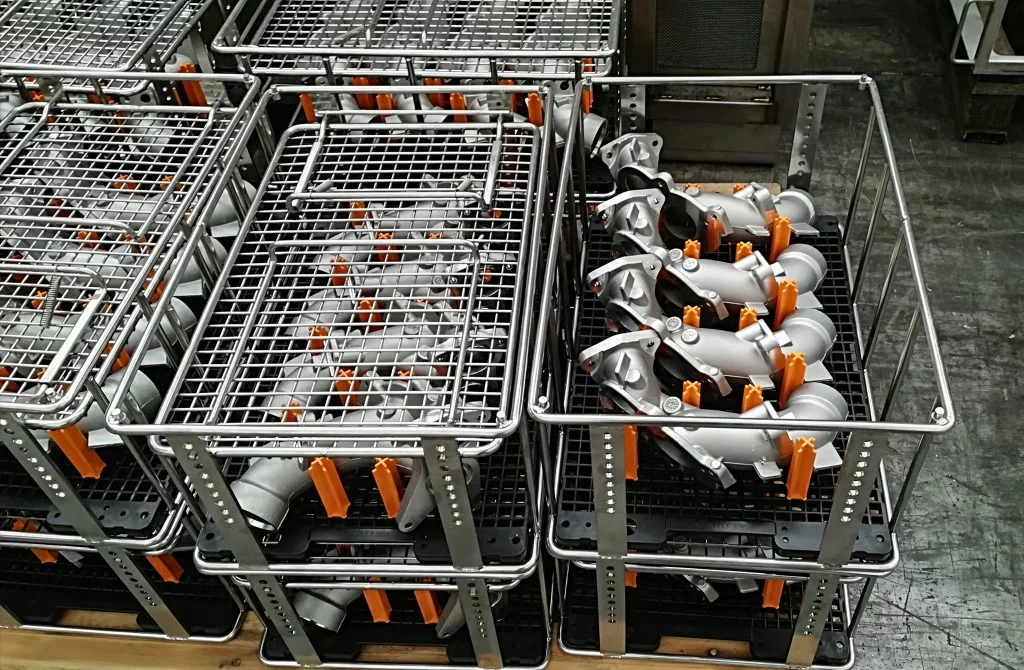
In the manufacturing sector, the stability of the industrial cleaning process contributes to production continuity by ensuring cleaning results that are consistent with the requirements of the component and subsequent manufacturing operations. For this reason, the choice of a cleaning system should not be based solely on its ability to remove contaminants, but also on its ability to manage the process in a controlled and repeatable way.
An industrial cleaning system should therefore be considered an integral part of the production process. Technology, cycle configuration, component characteristics and control methods must all be evaluated according to the specific application.
Cleaning process stability is important because it helps maintain treatment conditions that remain consistent over time with the level of cleanliness required by the application. When cleaning is part of the production process, consistent results also become relevant to subsequent manufacturing operations.
The final result does not depend solely on the technology used. Components that differ in terms of material, geometry, dimensions or type of contamination may require different treatment methods.
For this reason, Firbimatic develops solvent-based and water-based cleaning systems with detergents for different industrial applications, defining the system configuration according to component characteristics and process requirements.
The stability of an industrial cleaning process depends on the correct combination of the component, contaminants, cleaning technology and cycle configuration. The assessment must therefore consider all the variables that can affect the result rather than focusing on a single factor.
The main aspects to consider include:
The choice of process must be consistent with the actual operating conditions of the application. In solvent cleaning, for example, Firbimatic highlights the importance of selecting the solvent according to the contaminant to be removed and the material of the component.
Repeatability is essential because an industrial process must deliver consistent results not only during a single cycle, but throughout production. The ability to maintain controlled treatment conditions therefore becomes particularly important when cleaning is part of a manufacturing sequence.
In Firbimatic solvent cleaning systems, repeatability of results is identified as one of the key characteristics of closed-loop technology. The cycle can be configured through different treatment stages and adapted to the specific requirements of the application.
This approach makes it possible to consider cleaning not as a standardised and independent operation, but as a process that must be defined according to the characteristics of the component and the required result.
Automation and monitoring contribute to process control by making it possible to manage defined cleaning programmes and monitor the main functions of the system.
In Firbimatic solvent cleaning systems, the PLC allows different cleaning programmes to be managed and the stages of the cycle to be modified according to the application. Self-check and continuous monitoring systems also make it possible to monitor the main functions of the system.
Monitoring the conditions of the cleaning bath is also important in water-based cleaning systems with detergents. Checking the concentration of cleaning agents and the presence of contaminants helps keep process conditions under control and makes it possible to take action when necessary.
Automation therefore does not replace the correct design of the cycle: it helps make the conditions defined for the specific application manageable and controllable.
Cleaning efficiency depends on the correct combination of the different stages of the cycle because washing, rinsing, drying and component handling all contribute to the overall result.
Depending on the configuration, Firbimatic solvent cleaning systems may include pre-cleaning, cleaning, rinsing, vapour treatment and drying stages. The individual stages can be adapted to the characteristics of the component and the required level of cleanliness.
Basket movement can also be configured through rotation, oscillation and tilting systems. These methods are designed to support the cleaning action and the subsequent stages of the treatment process.
Drying is also an integral part of the cycle: Firbimatic offers different technical solutions according to the characteristics of the application and process requirements.
Solvent management is important because maintaining the condition of the process fluid is an integral part of managing the cleaning cycle. In Firbimatic closed-loop systems, the solvent can be recovered and regenerated through the distillation system integrated into the machine.
During the process, the solvent comes into contact with contaminants present on the components. Distillation makes it possible to separate the solvent from contaminants and make it available for reuse.
Solvent management is therefore integrated into the design of the system together with the other stages of the cycle. This makes it possible to consider cleaning, recovery and regeneration as parts of a single process.
An industrial cleaning process should be designed starting from the characteristics of the components and the specific requirements of production, through a preliminary analysis of the application.
Before defining the solution, Firbimatic carries out cleaning studies and tests on customer components. The company's technical centre is equipped with different types of systems to perform tests and evaluate the behaviour of components under different treatment conditions.
This approach makes it possible to analyse factors such as contamination, geometry, materials and the required level of cleanliness before defining the system configuration.
The design process can therefore take into account not only the cleaning result, but also the characteristics of the production process in which the system will be integrated.
Firbimatic designs and manufactures solvent-based and water-based industrial cleaning systems with detergents, developing standard, special and customised solutions according to component characteristics and application requirements.
The company has been operating in the industrial machinery sector since 1971 and has developed a division dedicated to Metal Cleaning, with solutions for different manufacturing sectors, including automotive, aerospace, medical and precision engineering.
The analysis of customer requirements and preliminary tests on components help identify the most suitable technology and system configuration for the process to be implemented.
To assess which industrial cleaning solution is best suited to your production requirements, contact Firbimatic and discuss the characteristics of your components, contaminants and production process with the technical team.
Consultez toutes les informations utiles et accédez au guide complet en quelques secondes.
Follow Us


We and selected third parties use cookies or similar technologies for technical purposes and, with your consent,
also for other purposes as specified in the .
If you close this banner with a tick or click on "Decline", only technical cookies will be used. If you want to select the
cookies to be installed, click on 'Customise'. If you prefer, you can consent to the use of all cookies, including
cookies other than technical cookies, by clicking on "Accept all". You can change your choice at any time.