
In industrial processes involving heat treatment of metal components, parts cleaning is an important step in ensuring the quality of the operations involved. Whether the process involves quenching, carburizing, nitriding, annealing, brazing or other furnace processes, contaminants can affect treatment conditions and compromise subsequent operations.
Cleaning before and after heat treatment serves different purposes: before treatment, it removes machining oils, emulsions and protective greases; after treatment, any quenching oils, cooling residues and contaminants that could interfere with further processing must be removed.
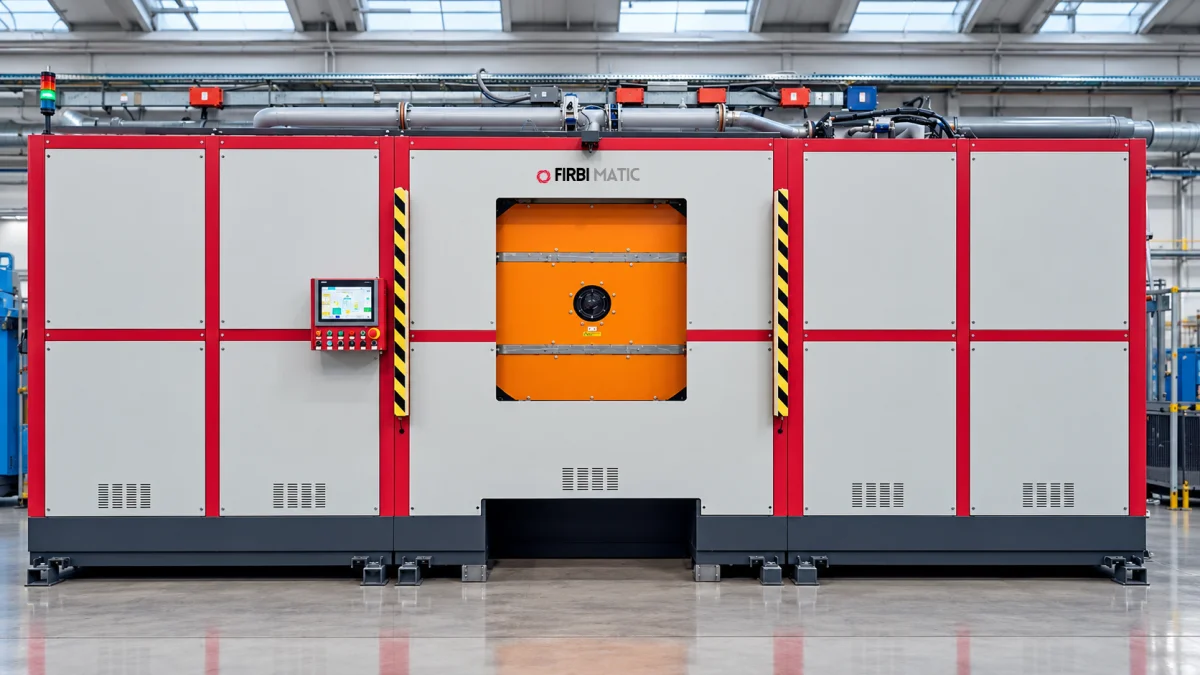
For these applications, Firbimatic offers a solvent-based industrial cleaning solution built around the EK 150 V system, configured to handle large metal components, heavy loads and complex geometries.
Metal components intended for heat treatment often come from previous machining operations and may carry cutting oils, metalworking fluid emulsions, protective greases and other production residues on their surfaces.
If not adequately removed, these contaminants may react at process temperatures, generate unwanted deposits and contribute to contamination inside the furnace.
Pre-treatment cleaning therefore aims to prepare the surfaces for subsequent heat treatment operations, reducing the presence of foreign substances that could interfere with the process.
Particular attention must also be paid to residual moisture and any traces of process chemicals left by previous operations. Managing these factors, together with proper drying of the parts, is especially important in treatments requiring controlled process conditions.
Cleaning requirements do not end when the components leave the furnace.
Depending on the treatment performed and the cooling method used, quenching oils, cooling residues and other contaminants may remain on the surfaces and must be removed before further machining, dimensional inspections or finishing operations.
One particularly relevant application is cleaning components after oil quenching, which requires removing oily residues from both exposed surfaces and less accessible areas of the parts.
Proper cleaning prepares the components for the next production stages while limiting the transfer of contaminants to other equipment and workstations.
One of the main difficulties is cleaning metal components with complex geometries, including cavities, blind holes, internal surfaces and areas where oils and other contaminants can become trapped.
Under these conditions, simple contact with the cleaning fluid may not be sufficient to reach every affected surface.
Another challenge is the need to process large components or particularly heavy loads while maintaining a cleaning process compatible with production requirements.
The choice of cleaning system must therefore take into account surface accessibility, the nature of the contaminants, load capacity and the level of cleanliness required for subsequent operations.
To address these application requirements, Firbimatic offers the EK 150 V configuration, an industrial cleaning system combining solvent flushing manifolds with immersion-bath cleaning.
Using both cleaning methods makes it possible to treat the external surfaces of components while promoting solvent contact with internal areas and more intricate geometries.
The system has the following technical features:
These features make the EK 150 V a solution designed for industrial applications that need to combine high load capacity with the cleaning of components featuring complex geometries.
In applications involving oils and organic contaminants, solvent management is important for maintaining consistent cleaning process conditions over time.
The EK 150 V incorporates a dual distillation system designed to separate the solvent from the contaminants collected during cleaning cycles.
The Energy Saving system is designed to optimize energy use during distillation, while the independent circuits support the organization of the system's various functions.
From an operational standpoint, the 12-inch control panel, automated maintenance system and redundant safety devices complete a configuration developed to meet the operating requirements of an industrial production environment.
Founded in 1971 in Sala Bolognese, Italy, Firbimatic designs and manufactures industrial cleaning systems, developing both standard and customized solutions for different manufacturing sectors. Through its Metal Cleaning Division, the company has built specialist expertise in cleaning metal components, including large parts with complex geometries. System design is supported by a specialized technical centre, where cleaning tests are performed on customers' components to identify the most appropriate technology and process conditions.
Do you need to integrate a cleaning system before or after heat treatment? Contact the Firbimatic technical team to assess the characteristics of your components and identify the industrial cleaning solution best suited to your production requirements.
Sehen Sie sich alle nützlichen Informationen an und greifen Sie in wenigen Sekunden auf den vollständigen Leitfaden zu.
Follow Us


We and selected third parties use cookies or similar technologies for technical purposes and, with your consent,
also for other purposes as specified in the .
If you close this banner with a tick or click on "Decline", only technical cookies will be used. If you want to select the
cookies to be installed, click on 'Customise'. If you prefer, you can consent to the use of all cookies, including
cookies other than technical cookies, by clicking on "Accept all". You can change your choice at any time.


